
The Case for Catholicism
Why do Catholics celebrate the Eucharist? Why do we venerate the Virgin Mary and the saints? Is all of this in the Bible? Or are these practices the Catholic Church added over time? Many Catholics face questions and criticisms that can make them think the Catholic faith is a distortion of what Jesus taught. In this series, we make the case for Catholicism: how we can respond to these objections and better understand how all these Catholic practices are rooted in Christian origins.
- Topics
-
Is the Catholic faith biblical? What about "Sola Scriptura"?
-
How to respond to Protestant objections to the Mass.
-
How to respond to objections against devotion to the Virgin Mary and the saints.
-
Your instructor
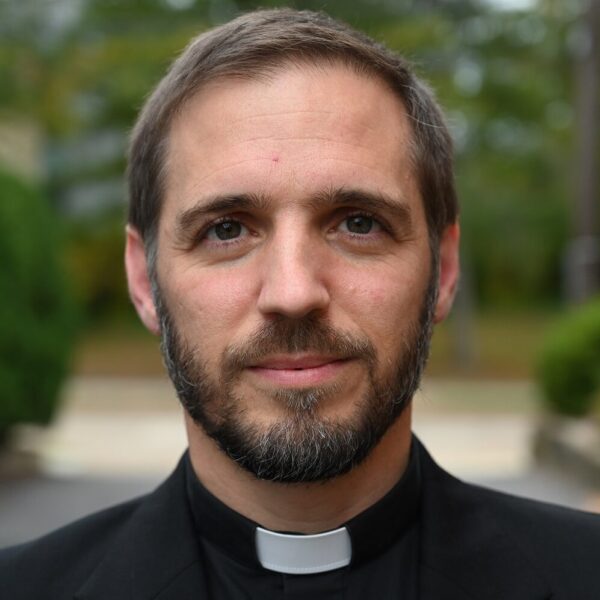
Fr. Lucas Laborde
priest
Father Lucas Laborde studied at Colegio La Salle in Buenos Aires. He holds a degree in Philosophy from the Universidad del Norte Santo Tomás de Aquino (Buenos Aires) and a degree in Theology from the Catholic University of America (Washington, DC). As a priest of the Society of Saint John, he served as chaplain of the Newman Center at Oregon State University and chaplain at American University in Washington. He has also been pastor of St. Patrick and St. Michael the Archangel (Portland) and Episcopal Vicar for Hispanic Ministry in the Archdiocese of Portland. He currently lives in Corvallis, where he serves as pastor at St. Mary's Parish.
The Truth has been accepted in the world not because of its character as a system, nor because of books, nor because of argumentation, nor because of the temporal power that supported it, but because of the personal influence of those who testified, being at the same time teachers and models.
John Henry Newman
Oxford University Sermons, V
Watch the Full Course on YouTube
The Case for Catholicism
-
How does it work?
1. Decide on how to use the course
You can take the course individually or as group as part of small faith sharing group.
Having a group of friends is not mandatory, but it is much more enriching. If possible, we recommend you consider finding two or three friends who will accompany you on this adventure to grow together in their faith.
2. Choose a course by clicking the icons below
After selecting a course by clicking the icons below, you will be taken to the YouTube channel where video and text references are provided.
3. Taking the courses
Each course will have an introduction and either three or four parts that include a video, reference text, and questions to ponder.
4. Course closure
At the end of the course, participants are welcome to provide comments and questions in the YouTube channel.
For those who have taken the course as group, we offer a final one-on-one meeting with the fellow to clarify any questions, explore topics in more depth, and build a personal connection with the other Newman Academy participants.